
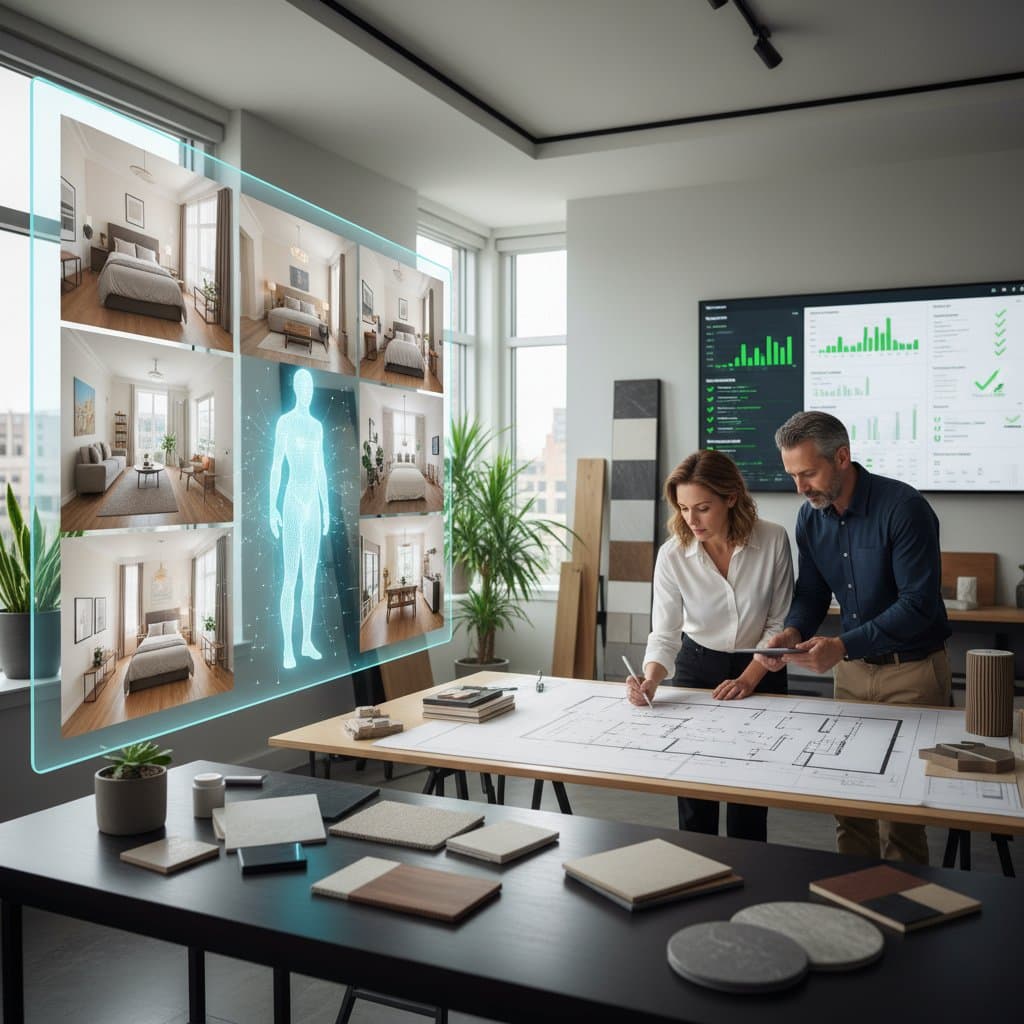
AI and Professional Designers: A Balanced Approach to Interior Design by 2026
Interior design stands at a pivotal moment. Artificial intelligence tools now enable rapid visualizations, precise budgeting, and efficient planning, potentially reducing costs by up to 40 percent. However, these advancements do not eliminate the need for professional expertise, which ensures compliance, material durability, and personalized outcomes. The optimal strategy integrates AI innovation with human oversight to create functional, safe, and aesthetically pleasing spaces.
Homeowners increasingly explore AI platforms for initial concepts, such as uploading room photos to generate layout suggestions. This shift prompts a key consideration: how to leverage technology without compromising on practical execution. Professional designers provide the critical layer of insight that addresses regulatory requirements, structural limitations, and long-term usability.
Essential Insights
- AI platforms halve planning time and minimize budget excesses via predictive analytics.
- Experts excel in regulatory adherence, material procurement, and superior finish execution.
- Optimal outcomes arise from combiningvisuals with professional coordination.
- Savings from AI integration vary from 15 to 40 percent, influenced by project scale and intricacy.
Evolution of AI in Interior Design
Contemporary AI tools extend beyond basic mood boards. They employ machine learning to assess room dimensions, evaluate lighting, and propose layouts that harmonize utility and aesthetics. Users upload images of their spaces and receive comprehensive redesigns within moments, complete with product recommendations and expense projections.
This capability empowers individuals to test ideas freely, evaluate styles side by side, and preview results prior to purchases. Integrated budgeting functions alert users when selections surpass financial limits. Such features democratize design access, allowing experimentation without immediate financial commitment.
Nevertheless, limitations persist. AI depends on pre-existing data sets and pattern algorithms, often overlooking site-specific elements like building regulations or material textures. A rendering that appears flawless digitally may falter in reality due to overlooked factors such as daylight variations or seamless floor integrations.
Strengths of AI Tools
AI addresses common hurdles in home renovation projects. It delivers early visual prototypes, alleviates choice overload, and facilitates clearer communication with service providers. Specific strengths include:
- Style Coordination: Algorithms analyze current furnishings to suggest harmonious colors and textures.
- Expense Monitoring: Real-time calculators update totals as users modify selections.
- **Layout ** Tools evaluate movement patterns and ergonomics to prevent cramped arrangements.
- Preview Simulation: Augmented reality enables testing of tiles or paints under actual illumination.
These elements position AI as a valuable resource for preliminary ideation. Users develop focused visions, compile references, and engage experts with refined briefs, thereby streamlining consultations and curbing misunderstandings.
Areas Where Experts Excel
Despite technological progress, licensed designers retain authority over safety, quality, and adherence to standards. They interpret codes related to electrical capacities, airflow, and load distributions. Virtual systems cannot verify if a fixture arrangement complies with regulations or if a surface withstands specified weights.
Designers also apply nuanced judgment attuned to lifestyle nuances, spatial emotions, and comfort dynamics. They evaluate endurance and market appeal in ways data models approximate but do not perfect. Procurement networks grant access to exclusive resources, ensuring installations meet rigorous criteria.
Professionals select fabrics resilient to moisture or activity levels, a detail AI suggestions may ignore. Their involvement safeguards against suboptimal choices that could lead to premature wear or functional issues.
Financial and Timeline Analysis
Opting for AI versus full professional services yields notable variances. Consider this overview by project category:
- AI-Exclusive Approach: Fees range from $50 to $200 per room for renders, with add-ons for lists or sessions.
- Expert Consultation: Hourly rates span $75 to $200, or flat fees from $1,000 per room for full packages.
- Integrated Method: Merging AI concepts with oversight trims expenses by 20 to 30 percent, particularly in simpler areas like studies or sleeping quarters.
Timelines differ as well. AI produces outputs swiftly, yet realization hinges on procurement, scheduling, and approvals. Designers expedite these by liaising with suppliers and orchestrating phases, mitigating postponements.
Integrating AI with Expert Guidance
A collaborative model emerges as standard. Initiate with AI for ideation and previews, then consult professionals for verification and adjustments. This method preserves innovation while upholding accuracy.
A standard sequence includes:
- Ideation Phase: Employ AI applications to explore motifs and schemes.
- Review Phase: Consult experts on suitability and fiscal fit.
- Execution Phase: Engage builders for modifications and completions under supervision.
- Verification Phase: Perform inspections for regulatory and visual alignment.
Budget-conscious owners benefit most, applying expertise selectively to complex zones like cooking areas while deploying AI for ancillary enhancements.
Indicators Requiring Expert Input
Digital plans can convey undue certainty. Watch for these signals of necessary professional scrutiny:
- Oversights in Structure: Inability to identify weight-bearing elements or concealed conduits.
- Illumination Errors: Failure to simulate diurnal light changes.
- Hue Discrepancies: Digital displays that diverge from physical applications.
- Placement Conflicts: Arrangements ignoring access to entries, openings, or systems.
Upon detecting such concerns, halt procurements or engagements. A targeted expert review averts costly corrections.
Expert Views on AI Adoption
Designers increasingly incorporate AI into workflows. It handles preliminaries, freeing time for innovation and oversight. Homeowners gain from accelerated customizations and enhanced quality.
Builders note improved interactions with visualized proposals, refining projections and alignments. Still, they emphasize on-site evaluations for dimensions, surfaces, and verifications remain indispensable.
Sustaining AI-Influenced Spaces
Post-completion, assess usability and ambiance. Does the environment perform as envisioned? This evaluation highlights the value of human refinement over pure computation.
Organize digital files and amendments for ongoing reference, aiding expansions or sales. Document selections meticulously, given evolving platform data.
For adjacent areas, adapt proven elements via AI, but validate contextual adaptations. Experts ensure seamless integrations across zones.
Strategies for Effective Implementation
To maximize benefits, follow these steps:
- Select AI platforms with robust privacy and accuracy features.
- Cross-verify AI outputs against room measurements using basic tools.
- Schedule professional input early to align visions with realities.
- Track project phases with shared digital folders for team access.
- Post-project, solicit feedback to refine future endeavors.
This disciplined integration yields spaces that endure, blending efficiency with excellence.