
Essential Spring HVAC Maintenance: Reduce Cooling Costs by 15 Percent
The arrival of spring brings warmer days and signals the need to prepare heating, ventilation, and air conditioning systems for upcoming heat. Homeowners may notice subtle issues, such as a slight odor from the unit, visible dust from registers, or unexpectedly elevated electricity usage. These indicators highlight the importance of a comprehensive maintenance routine, which enhances comfort, decreases operational expenses, and prolongs equipment durability.
A properly maintained system delivers consistent, fresh airflow on hot afternoons. This outcome results from deliberate care, thorough cleaning, and recognition of how minor adjustments yield significant efficiency gains.
Optimal Timing for Spring HVAC Assessments
Spring serves as the bridge between heating and cooling periods, positioning it as the prime season for evaluating system functionality. Units endure heavy use during winter, accumulating particles that impede air movement and compromise performance.
Well-maintained systems achieve cooling cost reductions of up to 15 percent. In various areas, regular upkeep leads to yearly savings ranging from $150 to $300. Beyond finances, these practices avert breakdowns, promote uniform air circulation, and preserve superior indoor air quality.
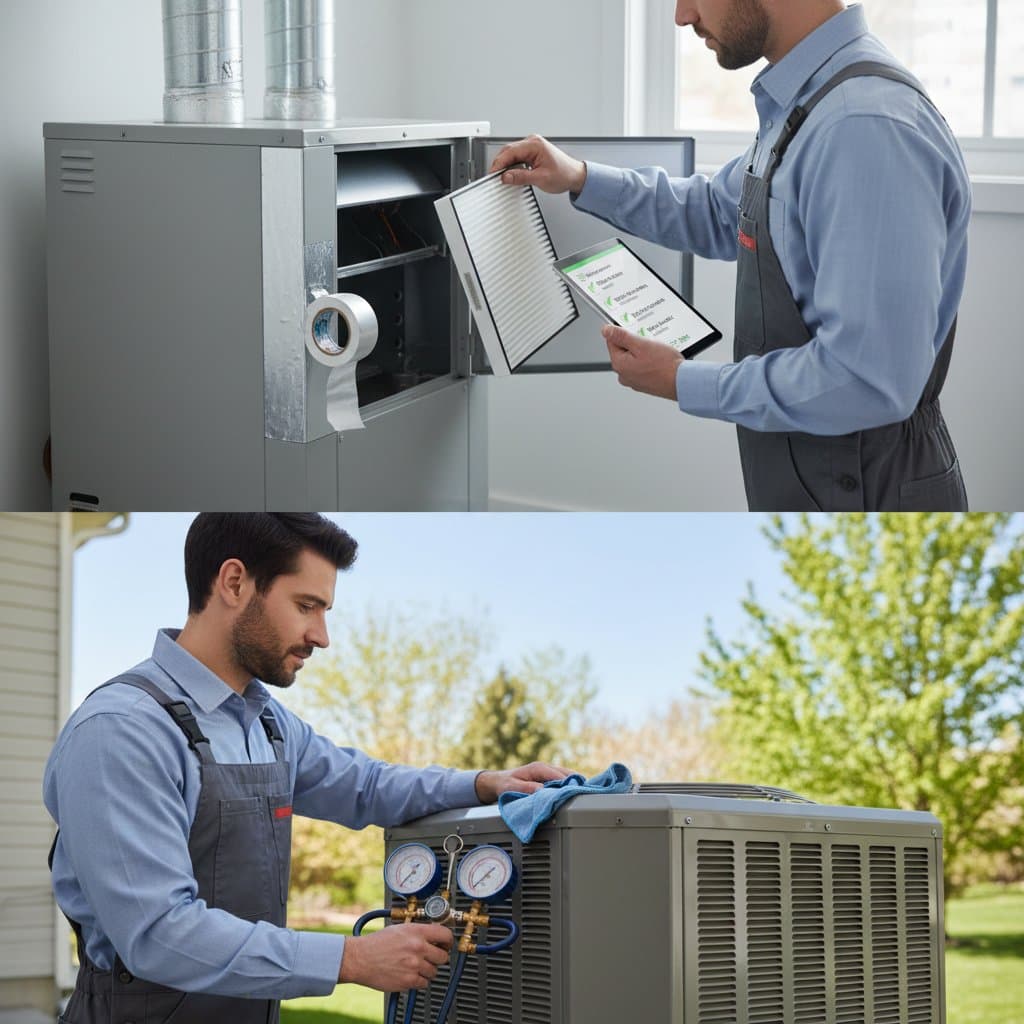
Step 1: Replace or Clean Air Filters
Filter maintenance stands out as one of the most impactful household tasks for energy management. Clogged filters hinder air passage, compelling the unit to operate under increased strain. This extra effort elevates bills and accelerates deterioration of vital parts.
Replace disposable filters every one to three months with models rated MERV 8 or higher for balanced filtration. For reusable types, rinse with a solution of mild soap and lukewarm water, ensuring full drying prior to reinstallation. In homes with animals or high dust levels, inspect monthly to sustain optimal air purity and system output.
Step 2: Remove Debris from Outdoor Units
Exterior condenser units attract foliage, branches, and soil during colder weather. Obstructions in this area lead to compressor overheating and reduced effectiveness. Begin by disconnecting power, then clear accumulations using a soft-bristle brush or low-suction vacuum.
Preserve a minimum two-foot perimeter by pruning nearby vegetation. For thorough care, detach the upper panel and hose down the coils at low pressure to straighten any minor bends. Professional services for severe grime or damage, priced at $100 to $200, ensure safe restoration of peak operation.
Step 3: Inspect and Clean Vents and Ducts
Ducts function as the respiratory pathways of a residence. Gradual buildup of particles and allergens within them diminishes efficiency and disperses contaminants. Vacuum reachable registers and polish covers with a damp microfiber cloth to capture fine residues.
Professional duct cleaning, performed by certified experts and costing $300 to $600 based on residence dimensions, enhances airflow by as much as 25 percent. Individuals with sensitivities to allergens report marked improvements in respiratory health following this procedure.
Step 4: Verify Thermostat Accuracy
Inaccurate thermostats misinterpret ambient conditions, triggering excessive on-off cycles that consume unnecessary power. Position a precise thermometer adjacent to the device and note any discrepancies exceeding two degrees Fahrenheit. Such variances necessitate adjustment or replacement.
Consider installing programmable or intelligent thermostats, which adapt to occupancy patterns and reduce consumption by approximately 10 percent. Initial setup expenses range from $150 to $300, with potential reimbursements from utility providers easing the cost.
Step 5: Evaluate Insulation and Air Sealing
System performance suffers without a tightly sealed envelope. Examine seals on windows and doors for wear, and detect air infiltration along floors or ceiling penetrations using your hand or incense smoke. Apply silicone caulk to gaps under one-quarter inch or expandable foam for larger voids to minimize losses.
Attics demand adequate insulation depth, typically R-30 to R-49 depending on climate. Deficient layers permit conditioned air to rise and dissipate. Blown cellulose or fiberglass additions, at $1.50 to $3.00 per square foot, recoup expenses rapidly via diminished energy demands.
Step 6: Arrange Professional Inspection
Home efforts provide a strong foundation, yet expert analysis uncovers nuances beyond basic reach. Technicians assess refrigerant charge, scrutinize wiring integrity, and quantify air velocity with specialized tools. Seasonal packages from service providers generally fall between $100 and $200.
These visits encompass part lubrication, drain line flushing, and performance diagnostics. For units over ten years old or prone to malfunctions, consultations on modern, efficient replacements prove valuable. Newer models offer 20 to 40 percent better energy utilization than predecessors.
Step 7: Conduct a Pre-Summer System Test
After completing preparatory measures, activate the unit on a temperate afternoon. Operate it for a minimum of fifteen minutes, observing output strength, uniform temperatures across spaces, and absence of irregular vibrations or hums.
Strategies for Effective Maintenance
- Record all activities. Maintain a detailed journal including replacement schedules, receipt documentation, and observation summaries to track patterns and validate guarantees.
- Address issues promptly. Indicators such as uneven temperatures or atypical sounds demand swift evaluation to avoid escalation.
- Employ monitoring devices. Energy trackers or advanced controls identify usage anomalies, guiding targeted improvements.
- Integrate with broader cleaning. Align HVAC tasks with general home refreshers, such as register polishing and fixture dusting, to amplify air freshness.
Building Long-Term System Reliability
Spring HVAC maintenance establishes a robust base for seasonal performance. Systems that receive consistent attention cool spaces more rapidly, operate with less noise, and endure extended service intervals.
Allocate time for these procedures to secure enduring benefits in ease, environmental responsibility, and budget management. The result manifests in a residence that maintains ideal conditions effortlessly.