
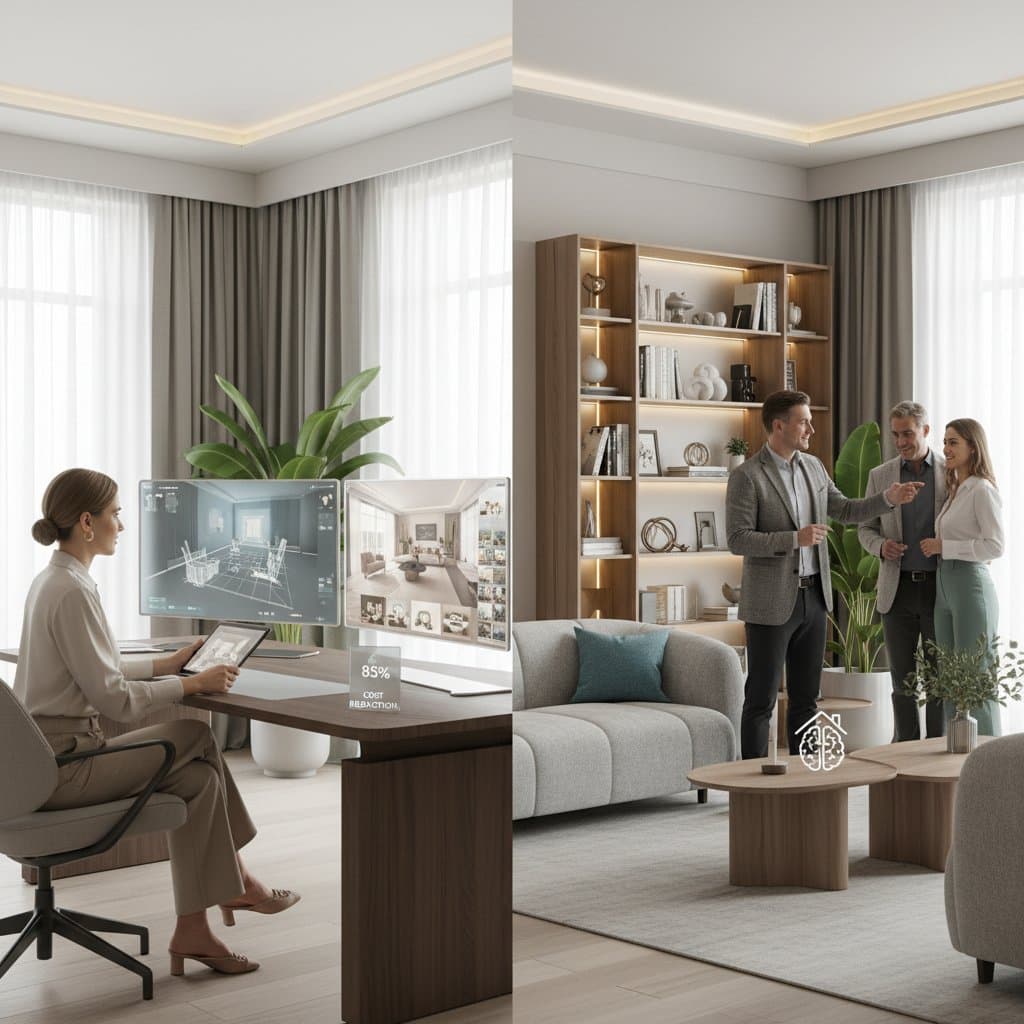
AI Versus Professional Designers: Substantial Savings on Home Redesigns in 2026
Home redesign projects frequently originate from a compelling image, such as a welcoming living room discovered online or an efficient kitchen configuration. Homeowners soon confront a key choice: engage a professional designer or rely on advanced AI design tools to realize the vision. The optimal approach aligns with individual objectives, financial constraints, and desired involvement in the creative process.
Artificial intelligence now disrupts the traditional domain of professional interior design. AI platforms produce comprehensive room layouts, color schemes, and furniture arrangements in mere minutes. This evolution presents homeowners with a clear alternative: achieve significant savings through AI or opt for the nuanced expertise of a human professional.
Advances in Digital Design Tools
Consider an outdated living room with bare walls and worn furniture. A homeowner uploads photographs to a tablet application and receives several reimagined versions of the space in seconds. The software automatically optimizes lighting, enhances traffic flow through layout adjustments, and aligns colors with stored inspiration images. Such capabilities define modern AI design tools.
Applications including RoomGPT, Homestyler, and DecorMatics employ machine learning to evaluate uploaded images and user preferences. These platforms suggest furniture selections, paint colors, and decor placements tailored to personal style and financial limits. Integrated shopping features enable direct purchases of recommended items. Tasks that previously demanded multiple consultations, hand-drawn sketches, and iterative revisions now conclude in one session.
The advantages extend to affordability. Professional interior designers typically charge between $100 and $250 per hour, leading to project fees of $5,000 to $20,000 or higher based on scope. AI design services, by comparison, cost $20 to $200 per room, varying with customization levels. For modest residences, this disparity allows redesigns across several areas rather than a single space.
Quantifiable Benefits of AI-Driven Design
Cost efficiency drives many homeowners toward AI tools. Examine a practical scenario: refreshing a 250-square-foot living room.
A professional designer may bill $3,000 to $5,000 for consultations, planning, and procurement assistance. Including furnishings and materials, the full expense often surpasses $10,000. An AI tool generates diverse layout proposals for $50 to $100, followed by budget-aligned online purchases. With $2,000 to $3,000 allocated to items, overall savings reach several thousand dollars, approaching 85 percent in optimized cases.
Beyond finances, AI accelerates timelines. Conventional projects span four to eight weeks from ideation to approved plans. AI delivers actionable concepts within hours, facilitating rapid refinements and style explorations. This accessibility democratizes expert-level design for users equipped with basic devices.
Guide to Implementing AI Tools in Home Redesign
Homeowners prepared to incorporate AI into design efforts can follow these structured steps.
1. Establish Objectives and Financial Parameters
Clarify project aims before capturing images, such as updating colors, improving layouts, or replacing furnishings entirely. Specify the total budget encompassing design fees and physical purchases.
2. Select an Appropriate Platform
Evaluate tools according to specific needs. Platforms like Planner 5D and RoomGPT prioritize spatial planning, whereas DecorMatics emphasizes inventory matching and stylistic harmony. Free trials allow testing multiple options to identify the best fit.
3. Input Data and Refine Outputs
Capture clear, well-illuminated photographs from various perspectives. The application generates redesigned visuals adjustable for colors, textures, and illumination. Users can designate items to preserve or exclude from existing setups.
4. Assess Feasibility
Virtual designs impress visually yet require real-world validation. Verify dimensions, access pathways, and proportional scaling prior to acquisitions. Outline proposed arrangements with tape to gauge practicality.
5. Procure and Execute Changes
Upon approval, acquire suggested products online or consult the plan during in-store visits. For self-managed installations, review assembly durations and precautions for substantial or elevated elements.
Scenarios Requiring Professional Expertise
AI excels in visualization yet falls short for complex undertakings. Structural alterations, including wall relocations or plumbing modifications, necessitate licensed professionals versed in regulations. Electrical enhancements and fixture installations demand compliance verification beyond AI capabilities.
Employ AI for preliminary ideation and prototyping, then engage experts for enduring changes. Professionals increasingly value client-provided AI visuals, as they streamline discussions and establish shared references.
Strategies for Optimal Results
- Integrate AI efficiency with professional insight. Leverage digital outputs for brainstorming, then apply sensory evaluations to finalize selections.
- Archive design variations. Retain records of each iteration to track progress and inform future adjustments.
- Initiate modestly. Focus on one area to master the process before expanding, balancing technology with personal input.
- Solicit external input. Present renderings to peers or online forums for constructive critiques that refine decisions.
- Prioritize enduring quality. Select timeless elements over transient suggestions from algorithmic recommendations.
Sustaining Design Harmony Over Time
After implementation, observe the space in daily use. Monitor light patterns, workflow adaptations, and overall usability. AI designs offer adaptability, permitting revisits to original files for modifications or thematic shifts without full restarts.
For projects involving designers, arrange periodic reviews to address evolving needs. This practice connects initial visions to practical realities, preserving aesthetic and operational value long-term.
Home design in 2026 thrives on synergy between AI precision and human discernment. This combination yields economical, eco-conscious environments that resonate personally. Regardless of starting point, the result is a residence that embodies individual essence throughout.